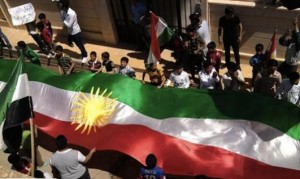
Source: Next Century Foundation's Syria and Lebanon Working Group
The Kurdish Opposition perspective
This report:
1. Includes a statement on recent developments in Syrian Kurdistan by Lokman Hamkaflo (Kurdish independent politician)
2. Includes a statement on recent developments in Syrian Kurdistan by Hejar Ibrahim Mustafa, founder of the group named “The Youth of the Syrian Revolution in the UK”
3. An NCF translation of the Arbil agreement between Syria’s Kurdish National Council and Syria’s PYD group (the political wing of the PKK Syria)
4. A glossary of groups, terms and other issues discussed in the above
The situation in Kurdish Syria
The Kurdish opposition in Syria is split into two major groups:
1. the KNC or Kurdish National Council which is itself a recently formed alliance of a number of predominantly secular groups (including KDP and Yakiti)
2. The PYD (often described as the political wing of the PKK) which is a well armed group that administers and controls much of the Western area of Kurdish Syria. The PYD is the principal group in the coalition known as the People's Council for Western Kurdistan (PCWK). PCWK is therefore the coalition and not the PYD but the PYD basically heads it.
3. There are also some minor parties that stand outside these groups, some of which have considerable prominence like the late Mashal Tamo’s Kurdish Future Party
Mr Massoud Barzani, President of the Kurdistan Regional Government of Iraq, called the KNC and PYD together in Arbil, Iraq, and brokered an agreement between the two parties in the hope that, in future, they would work together.
President Barzani has also been retraining Kurdish defectors from the Syrian Army and has formed them into a crack Peshmerga unit numbering at least 700 (some reports suggest considerably larger).
Notes on a conversation with Lokman Hamkaflo, Kurdish independent
Barzani has somewhere between 1,000 and 3,000 troops in Syria. These are Syrian Kurds who he has trained as Peshmerga. You want to know why the Turks hesitate to invade Syria? Do you remember the fuss that was made in Turkey over the picture of President Obama on the phone with Turkish Prime Minister Recip Tayyip Erdogan while holding a baseball bat? That picture really upset the Turkish media because it reflects reality. The USA controls Turkey. The Turks were angry about what was happening in Syria but they got a call from Obama. Which is why Turkey hesitates to mess with Syria.
And Barzani is not stupid. He tells the Turks that he’s training these people because he doesn’t want the PKK to control Syria.
All of this is down to Barzani who made an agreement between the KNC (Kurdish National Council) and the PYD (the political wing of the PKK in Syria). I believe it is essential that this agreement holds. Anything else would be a red light for me. Because we have a potential civil war between the PKK and Barzani’s militia.
The PKK are trying to unite with the KNC to get unity and show Turkey that they, the PKK, are not in sole charge.
The PYD and the PKK have made a joint High Commission because the PYD are desperate to say “We are not taking over. We are just managing things.”
The KNC don’t trust the PYD. We had a meeting on Sunday (12 August) to try and unite our factions here in the UK. But we failed to form a national council for all the Kurdish opposition in the UK because parties like the Yakiti and Wahada did not agree on a 5 by 5 split on the executive body. (the PKK and the KNC have a five / five split on the new executive body within Syria under the terms of the Arbil agreement negotiated under Barzani’s watchful eye). They (the PKK/PYD) are one party. The KNC are lots of parties. It should be a 5/7 split not a 5/5 split, they say.
The executive council formed in Arbil has not been replicated across Europe nor in the UK. I am very worried about the possibility of a Kurd-Kurd civil war. As long as they are united in Syria, I do not care what happens here. But there is no question – the PYD are trying to take advantage.
At the top level there is an agreement. Underneath there is a lot of tension. There have even been kidnappings and bullying by PYD. Kidnappings have happened more than ten times in the last two months in the Kurdish area. The Azadi Party are strong in Afrin and Qamishli and they have nearly started to fight the PKK / PYD.
Meanwhile they’ve been at war in Aleppo. So sad. The FSA tactics were so incompetent. Salahaddin has almost been completely destroyed by the government. The PKK have been more successful, and managed to ensure that none of our people have been killed by the government. Once Syria is liberated from the government we will be in a strong position.
We won’t announce autonomy until there is a strong foundation in place (between the PYD and the KNC), including agreement on the constitution and who manages the various areas.
Barzani is the daddy in terms of finance and everything. But we helped Barzani in the fight against Saddam. So his help for the SNC is payback. Plus Barzani doesn’t want to go up against the PKK because they might take over in Turkey. You see Turkey could have its own problem in a few months’ time. After all, there may be democracy in Turkey – but there is no democracy for the minorities in Turkey.
But the PYD and the KNC will sort out their differences unless Turkey gets involved and supports the KNC. Which is possible. Turkey won’t stay quiet.
Of course, the Turks would be tempted by the idea of establishing a safe haven inside Syria. But with Massoud (Barzani) involved, that would have to be between Aleppo and the border – but not in the Kurdish area. If I were Erdogan (Turkish Premier), I’d give my support to Barzani to weaken the PKK.
The PYD (PKK) is very strong. That is why the Kurdish area has not been touched (by the Syrian government).
But I am prepared to go and fight in Kurdistan if Turkey gets involved. Not just me. All the Kurds in Europe will go back home and fight.
Notes on a conversation with Hejar Ibrahim Mustafa, founder of the group named “The Youth of the Syrian Revolution in the UK”
You ask about the militant Ahrar al-Sham group. Ahrar al-Sham claims they are the primary supplier of weapons in Aleppo. You wanted to know about the Kurdish group fighting with the FSA. Kurdish branches do not fight except for a group which calls itself Salahadeen. The say they are part of the FSA. They go to Aleppo to fight as well as bringing weapons to help the other rebels. They are made up of young Kurds from Afrin who did not want to join the Syrian army.
Some Kurds are supplying weapons to the rebels after threats from the FSA that if they do not the FSA will move to control their towns and villages.
The agreement between PYD and Kurdish National Council has not broken down yet [referring to the Erbil Agreement, July 11 2012]. But in a few months it may break down. The PYD agreed to it to protect their interests. In the event that Bashar goes, an agreement with the Kurdish National Council means they will be allowed to stay and not be seen as allies of the old government. The Erbil agreement is held together ‘on egg shells’.
The KNC has less power in one sense because the PYD is an armed group whereas the KNC is not. This gave the PYD some strength when negotiating to the KNC. However, the KNC are now bigger than the PYD in terms of support.
Kurdish youth movements which had previously been stopped from protesting by the PYD [against the Assad government] are now being allowed to do so.
The Freedom (Azadi) Party has been fighting the PKK. They are a small Kurdish party.
Since the Erbil agreement, the PYD and KNC are now seen as joint, and have a mixed logo (a KNC logo on a PYD flag) and refer to themselves as KNC-PYD. There are still meetings in Erbil, they say that the PYD have to remove checkpoints and put down weapons and become a mainstream political party. But the PYD won't drop their weapons.
There are some Iraqi Kurds and some Syrian Kurds (who were army defectors) that have been trained by Barzani which have been sent to Qamishli. This is a Peshmerga unit. Some say it has 5,000 members (but that is Facebook which is unreliable) others like my own father say 700 (and he is more reliable).
The SNC (Turkish based Syrian National Council) see the Kurdish fighters as Barzani’s men. This is not what the SNC wants as it is not representative of Syrian view. Sunni politicians are particularly incensed at seeing the Kurdish flag on the uniformed arm of soldiers and the absence of the Syrian revolutionary flag. The PYD continue to oppose the use of the Syrian revolutionary flag.
Jisr al Shigur (border town) is now FSA controlled (not Kurdish).
It would not be too difficult to remove the PYD with enough effort. The reason it hasn’t happened so far is that people (other Kurdish opposition) are scared of them.
Western states have a private agreement to protect the Kurds. The Kurds are seizing the opportunity presented by the current crisis to consolidate their future in Syria and make a Kurdish autonomous state or region. As a Kurd, I myself oppose a totally separate Kurdish state. I want to see a united Syria. However, Kurds win whichever way the civil war goes.
When the Sunnis ran away in Kobani, in the Aleppo suburbs and in Afrin, the Kurds saw this as an opportunity. They filled vacant posts in post offices, banks, police stations etc. with Kurds so it proves that Kurds can unite and govern themselves. (The idea being when the Civil War ends the Kurds can turn around and say they have proved the can govern themselves and there is no need to return to centralised control.)
People (Arab refugees) are trying to hide in the Kurdish area but the PYD doesn't like to host non-Kurds as refugees as "this is Kurdish land".
The Kurds of Aleppo province and Ephrin are technically under the control of KNC-PYD but in reality have more of a PYD ‘flavour’. Whereas in Qamishli they are under the control of Barzani trained men but with a KNC ‘flavour’. The PYD is in Afrin with the Kurdish Youth Movement.
I am planning to go back to Afrin as soon as I can.
The Arbil agreement between Syria’s Kurdish National Council and Syria’s PYD group (the political wing of the PKK Syria)
11th July 2012 Meeting between the KNC (Kurdish National Council) and the PYD (representing the PKK). There was a meeting in Hawler (Arbil) and:
Some of the points previously agreed on with regard to power sharing and an end to fighting were accepted.
1. The parties to the meeting agreed to form a Supreme Council between the councils of the PYD and KNC.
2. This Supreme Council to consist of ten people – five from each existing council – and to be called the “Supreme Kurdish Council”
3. To have three special sub committees, each formed on a 5 x 5 basis
Committee to set up the foundation for long term control in the Kurdish area.
i.To deal with national (internal) relations between the parties
ii.A foreign affairs committee with authority to negotiate and establish a relationship with the Syrian Arab opposition and the other Kurdish political parties and Kurdish expatriates outside Syria, also other nations and other organisations such as the UN, taking decisions based upon the decisions of the Supreme Council
iii.Putting the right person in the right place according to qualification and experience
iv Committee to deal with internal issues such as services
v. Security Committee to protect the Kurdish area and the Kurdish populations in other areas (e.g. “Greater Damascus” and “the border region”).
The Supreme Council to establish “tools” to enable the implementation of these steps. All committees formed on a 5 x 5 basis.
4. The PYD is currently part of a committee led by the NCC (National Coordinating Council). This meeting recommends (but does not demand) that the PYD study the possibility of suspending PYD membership in the NCC.
Glossary of terms and issues
A KURDISH STATE: Many Kurds see the borders between countries (Iraq, Syria, Turkey and Iran) in the area as almost arbitrary. Fawaz Gerges, professor of Middle Eastern Politics at the London School of Economics (LSE), has said: “"The exit of Assad's forces from the Kurdish areas has complicated the crisis and deepened Turkey's fears that its borders with Iraq and Syria will be volatile for years to come... Many of the problems in the contemporary Middle East are traced to that colonial-era Sykes-Picot map... National borders do not correspond to imagined communities... the current uprisings have starkly exposed the fragility of the colonial system imposed on the region.”
Kurds have cleverly moved in to run institutions (such as police stations) left empty when Assad’s men left (Kurds have recently appointed their own mayor in the town of Kobani as well as controlling areas such as Derik, Amude and Afrin). This means when the fighting ends the Kurdish people can say that they have already become autonomous and capable of ruling themselves.
However, whereas in Iraq the Kurdish population is largely concentrated in one area, in Syria a very large number of Kurds live in areas (or suburbs) of Damascus and Aleppo, which are not in what would be considered part of a Syrian Kurdistan region in the north east of the country. This might make creating a separate homogenous Kurdish region difficult.
In general, the Kurdish dealings with the conflict in Syria can be described as mixed, “By quietly assuming local authority, they are hedging their bets. In the unlikely event that Mr Assad survives, he will owe them a favour for staying out of the fight. Should he lose, his successors will inherit a de facto Kurdish autonomous region much like Iraq’s.” Such evidence of sitting on the fence can be seen in reports of Kurdish action in Aleppo. They have agreed with the FSA that they will not fight them and in turn do not want the FSA to attempt to ‘liberate’ Kurdish areas – they want to be left out of the conflict.
AGREEMENT/DISCORD BETWEEN THE PYD AND THE KNC: Relations between the PYD and the KNC are encountering problems since their commitment to cooperation last month in the Erbil Agreement. The union between the two is now being referred to as the Kurdish Supreme Committee (KSC) and aims to ensure that towns run by Kurds are run by a unified Kurdish authority.
An armed fighting force meant to represent the KSC is the
People’s Defence Union (YPG) however some other analysts believe the YPG is an extension of the military power of the PYD.
AHRAR AL SHAMM (EXTREMIST): This takfiri group is based in the historic village of Qalaat al Mudiq, close to Aleppo, and sends the rebels under its command to fight in the streets of Aleppo. Ahrar al Sham draws its members from followers of a conservative strain of Sunni Islam known as Salafism; its followers see themselves as fighting in part for the right to preach their doctrine and the fall of a government that jailed them for doing so. “Things are going on as usual, (in the areas under Ahrar al Shamm control) except that it became hard for Alawites to come to work,” says Khalid al Amin, the Ahrar al Sham leader. Amin said Alawites now fear retaliation from Sunnis for the support in Alawite villages for pro-government militiamen (Shabiha).
NATIONAL COORDINATION COMMITTEE (NCC): Made up of 13 left-leaning political parties, three Kurdish political parties, and independent political and youth activists. It gathered most of the political parties of the National Democratic Rally, formerly Syria's main secular opposition coalition, as well as other organizations. It has more modest aims than the SNC and does not call for the complete overthrow of the Syrian government. It is very strongly opposed to foreign intervention in Syria. Along with almost all other secular opposition groups, it calls for conditional dialogue with the government, arguing that it remains the least costly route to political transition. It is led by the veteran opposition figure Hussein Abdul Azim who has said, "We reject foreign intervention - we think it is as dangerous as tyranny. We reject both." The Coordination Committee's spokesperson abroad is Haytham Manna, a Paris-based author and human rights activist, who is also spokesperson for the Arab Commission for Human Rights (ACHR). He has described the SNC as "a Washington club" and said he considers anyone calling for foreign intervention a "traitor".
THE AZADI (FREEDOM) PARTY: The PYD accuses Mustafa Juma and Salah Badr al-Din from the Azadi Party of getting support from Turkey to challenge the PYD.“Salah Badr al-Din went to Turkey to prepare people with weapons to target the PYD,” a PYD source said. The PYD’s armed committee captured Juma near the border on the 24th of June and released him three days later. PYD leader Salih Muslim told Barzani that if Juma’s group “provokes and attacks the Kurdish people, you will be responsible.” Conflict between the PYD and other Kurdish groups has also occurred because of arguments over supporting the FSA.
Early in July, the PYD clashed with Kurds affiliated to the FSA. The Kurdish Salahadin brigade, affiliated with the FSA, responded to the incident by saying they would target anyone who was “against the Syrian revolution” and blamed the PKK for kidnapping Kurdish activists and members of youth groups. According to a member of the Azadi (Freedom) Party, a previous agreement attempting Kurdish unity failed “because the PYD didn’t comply with the agreement and continued to arrest activists and torture Kurds, and attacked houses and killed innocent people. The Azadi Party was the only party that stood against such acts and criticized this method.” More recently, Mustafa Juma has said “If the PYD becomes a political threat in the future, a conflict between them [the PYD and the FSA] is imminent.”
THE FSA SALAHEDDIN BRIGADE (SECULAR): This FSA command is the only non-Sunni Arab brigade in the entire FSA. It is Kurdish and fights alongside the FSA in Aleppo. It opposes the PKK and is unique in that all other Kurdish groups (and indeed virtually all other minorities) either stand with the government or stand aside.
THE INVOLVEMENT OF IRAQ’S KURDS: Saleh Muslim (leader of the PYD) has sent a delegation to meet with officials in Iraq’s Kurdistan region. They discussed the issue of returning Kurdish soldiers who had defected from the Syrian army back to Syria. In a recent interview with Al Jazeera, Barzani said that defected soldiers were trained in the Kurdistan Region and would be sent to Syria to help with any “security vacuum” that might emerge. The YPG recently claimed it stopped Barzani-trained former Syrian soldiers from entering Kurdish areas.
However, the more controversial issue is the involvement or otherwise of Peshmerga (a term used to refer to a group of Kurdish fighters and in this case, specifically the fighting units of Iraq’s Kurdistan region).
Saleh Muslim said that he would only ask for Peshmerga forces to be sent in if it was necessary: “The discussion was about the return of Kurdish soldiers who defected from the Syrian army and are now in the Kurdistan Region... But Syrian Kurdistan does not need assistance from the Peshmerga forces at this point and if the need arises we will ask for their help.”
However, the Peshmerga have been accused by some members of the Arab opposition of moving into Syria. Kamal al-Labwani, member of the external opposition, said “We have information that a number of Peshmerga members entered the Kurdish areas in Syria and they are fighting now side by side with other Kurdish armed groups.”
The Kurdistan Region Presidency replied, “A number of newspapers and websites have published reported that Kurdish Peshmerga forces have entered Kurdistan of Syria, but we firmly reject that news as baseless and far from the truth.”
Meanwhile, Barzani has problems of his own in Iraq, where his Peshmerga were involved in a standoff with Iraqi troops in a dispute over revenue transfer from the government. Peshmerga forces have also stopped Iraqi forces from controlling the border with Syria. Superficially this would seem a dangerous escalation in relations between Iraqi Kurds and the Iraqi central government and the possibility of violent confrontation between the two now “cannot be excluded”. However, NCF sources indicate that this particular crisis has since been defused and currently there is some measure of rapprochement between Barzani and Malaki.
THE KNC: The Kurdish National Council was founded in Erbil in October 2011, under the sponsorship of President Massoud Barzani, of Iraqi Kurdistan. It comprises of 15 Kurdish political parties, such as the The Azadi (Freedom) Party and the Kurdish Left Party.
THE PYD: The PYD (Democratic Union Party) is a Kurdish party which is accused (especially by Turkey) of having strong ties with (or indeed that they are essentially the same organisation as) the PKK, a militant Kurdish group operating in Turkey. Some reports indicate that the PYD have in the past flown PKK flags in areas under their control. Turkey is extremely worried by this link, because a PYD controlled area in Northern Syria would allow the PKK a safe launching point for attacks into Turkey. But PYD leader Mohammed Saleh Muslim has told Turkey that the Turks have “nothing to do with the Syrian Kurds” and that they will not allow Turkey to interfere in their affairs. The PYD is the principal group in a coalition known as the People's Council for Western Kurdistan (PCWK).
THE RELATIONSHIP WITH TURKEY: is one area that creates immense tension between Kurdish groups. Turkey is attempting to forge closer ties with President Masoud Barzani. Though this may be largely related to energy and business concerns, it also might be seen as a way to exclude the PYD. The PYD were not invited to a meeting to discuss Syria last week in Iraqi Kurdistan, which included the Syrian National Council (SNC), the KNC (which has very close ties to Barzani) and the Turkish Foreign Minister. Jordi Tejel Gorgas, an author on the issue of Syrian Kurds, has said: “I think they [Turkey] are trying to marginalize the PYD in Syria by establishing good relations with the Kurdish National Council, which is very close to Masoud Barzani.” The PYD also objects to the inclusion of the SNC, “As it is not a group representing the interests of people in Syria but rather takes orders from exiles (and is very close to Turkey)”.
Allthis information was originally published on the superb
Next Century Foundation's Syria and Lebanon Working Group