Showing posts with label Turkey. Show all posts

Wednesday, 19 September 2012

New Statistics Reveal the Size of Turkey's Kurdish Population

Source: Rudaw in English

key
The Turkish Statistical Institute (TurkStat) recently published the birth records of Kurdish citizens in Turkey.

According to these records, there are 22,691,824 Kurds in Turkey, mostly born in Kurdish cities in the southeast of the country. Therefore, out of Turkey’s 74.7 million citizens, more than 30 percent are Kurds. These records only include people who have been registered at official government institutions.

Read the full article New Statistics Reveal the Size of Turkey's Kurdish Population

Saturday, 15 September 2012

Ultra Left critique of the PKK

Source CPGB

Northern Kurdistan,
Rejection of Marxism

Continuing his examination of the various programmes of the Turkish and Kurdish left, Esen Uslu looks at the new-found ‘democratic confederalism’ of the Workers’ Party of Kurdistan

After perusing the programmes of the legal TKP and ÖDP, we will now take a look at the programme of the Workers’ Party of Kurdistan (PKK).

Contrary to the view of many, who regard the PKK as a nationalist guerrilla movement, at its inception the founding members of the PKK were not Kurdish nationalists - at least not in the sense that the term could be applied to several remarkable Kurdish organisations in Iraq and Turkey, first and foremost among them the Kurdistan Democratic Party.

The initial bunch of PKK leaders, including comrade Abdullah Öcalan, had their roots in the revolutionary Marxist organisations of the late 60s and early 70s. However, since its foundation the PKK has passed through several political and ideological bottlenecks resulting in a change of programme - among the Turkish left there is a tendency to despise such programme changes.

We must bear in mind that the PKK has been engaged in open warfare since 1985, and despite suffering heavy losses it has still maintained substantial support among the population of Kurdistan. Considering the frozen nature of the Turkish left’s positions on the national question, the PKK’s attempts to understand the rapidly changing realities of the region and adjust its programme accordingly is actually commendable.

Read the full article Rejection of Marxism

Note. THE CPGB area minute ultra left sect in the UK, previously The Leninist tendency in the Communist Party, they have been linked to Trotskyist facts in Turkey. I decided to poublish it because it is quite an interesting take on the PKK

Tuesday, 11 September 2012

Turkey should resist urge for war with Kurdish militants -ICG

Source: Chicago Tribune News

More than 700 people have been killed since parliamentary elections in June last year, making this the deadliest period since the capture of the PKK's leader, Abdullah Ocalan, in 1999, the International Crisis Group (ICG) said in a report.

"Stepping up the struggle to wipe out the insurgency by physical frontal assault, even if understandable, will never be enough to solve the conflict and will bring thousands of deaths that will push more Kurdish youths to take up arms," it said.

"The government and mainstream media should resist the impulse to call for all-out anti-terrorist war and focus instead, together with Kurds, on long-term conflict resolution."

Read the full article Turkey should resist urge for war with Kurdish militants -ICG

Monday, 10 September 2012

Gulenists’ Kurdishphobia

Source Kurdistan Tribune


"A phobia is defined as the unrelenting and irrational fear of a situation, activity or thing that causes one to want to avoid it. Today the Gulenists’ media is bombarding audiences with a series of flatly untrue stories that render the Kurdish elected BDP party and the Kurdish rebel PKK within a framework of hostility, if not terror. The Gulenists’ mediascape arguably does not represent the Kurdish cause in a fair and true light; stereotypes that deem the BDP as a dangerous and disruptive force pervade the media" writes Dr Aland Mizell

Dr. Aland Mizell is with the University of Mindanao School of Social Science, President of the MCI and a regular contributor to The Kurdistan Tribune, Kurdishaspect.com, Mindanao Times and Kurdish Media.You may email the author at:aland_mizell2@hotmail.com


Read the full article Gulenists’ Kurdishphobia

44 journalists before a Turkish tribunal: A shameful press trial – for Europe as well as for Turkey!

Source: Kurdistan Tribune


Doğan Özgüden, Info-Türk Chief Editor, issued the following declaration on September 9, 2012, on the occasion of the 60th anniversary of the beginning of his journalistic career in Turkey:

I began journalism in the Republic of Turkey at the age of 16 years in Izmir on September 9, 1952. It was the first years of the Democrat Party’s power having promised a real democratization in the country. However, at that date, 184 personalities, of whom many were writers or artists of the country, were already behind iron bars on charges of belonging to a communist organization. It was followed by the arrest of many journalists or writers whatsoever be their political opinion.

A group of Turkish Army’s officers overthrew the DP on May 27, 1960, by a military coup with the promise to establish a democratic regime. However they refused to release Kurdish intellectuals already in prison. Moreover, they did not delay to deport many distinguished Kurdish intellectuals and to put in jail our internationally known writer Aziz Nesin and courageous journalist Ihsan Ada.

The main target of the repression during the period of coalitions, military coups of 1971 and 1980 as well as during post-modern coups of the end of the 20th century and beginning of the 21st century was always journalists, writers, artists and the defenders of the rights of the working people, the Kurdish people and the national minorities.

During my 60-year career as a journalist, including years of exile, I have only known repression, legal proceedings, trials, condemnations, exile and menaces of death.

The details and proofs of this disrespect of the freedom of expression can be found in my 1000-page memoirs, published in two volumes under the title of “Stateless” Journalist.

At this 60th anniversary of my career as a journalist, I do not wish to talk about my problems and fights. I solely wish to put emphasis on the deplorable situation of the freedom of expression and the press in a country that is always a member of the Council of Europe, the Organization for Security and Cooperation in Europe, and NATO, and a candidate to the European Union.

In three days’ time, it will be the anniversary of the bloodiest putsch of the last century: the September 12, 1980 Coup.

In spite of all claims of democratization, the constitution of the putschists always remains in force and the repressive practices against the Kurdish people and national and confessional minorities continue with the same atrocity.

As for the numbers:

So many journalists, currently about a hundred, had never been behind iron bars before the AKP came to power.
So many political men or women, currently several thousands, had never been behind iron bars before the AKP came to power.
On September 10, 2012, 44 journalists will be tried at a Turkish tribunal on charge of “terrorism”.

The people of Turkey, with Turks, Kurds, Armenians, Assyrians, Greeks, Jews and more than 50 ethnical groups, do not deserve it.
The European peoples who consider the European Union as a project of cohabiting in peace and social justice do not deserve it.
Shame on Turkey’s political leaders who consider themselves as heirs of 16 “Turkish States” founded during centuries, who have the ambition to see Turkey as the second strongest state in the European Union after Germany, who use all means for establishing a neo-Ottoman hegemony in Middle East as a regional superpower.

Shame on European leaders who carry on bargaining with Turkey by considering it as a reliable partner for the European Union, who remain silent before the permanent violation of the freedom of expression, and who give Ankara whatever concession to obtain the votes of the citizens of Turkish origin.

Brussels, September 9, 2012

Doğan Özgüden, Chief Editor of Info-Türk

INFO-TURK: 53, rue de Pavie, 1000 BRUXELLES, Tel: (32-2) 215 35 76, Fax: (32-2) 215 58 60

Friday, 7 September 2012

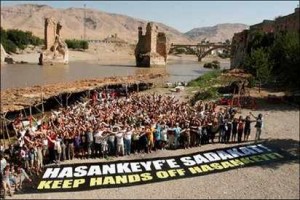
Hands off Hasankeyf!

Source: Kurdistan Tribune


Despite opposition from local Kurds and conservationists across the world, the Turkish government looks set to press ahead with its Ilisu dam project. This will flood the historic town of Hasankeyf – one of the oldest continually inhabited places in the world – and forcibly displace around 55,000 people from dozens of villages in Batman and adjacent provinces of Turkey/north Kurdistan.

Read the full article Hands off Hasankeyf!

Wednesday, 29 August 2012

Syria: The Kurdish Wild Card

Source: Truth Dig


"That incident symbolizes the complexities facing Kurds, an ethnic minority making up an estimated 10 to 15 percent of Syria’s population of 22 million. Kurds face discrimination and repression under Assad. But when they took up arms against the Syrian regime, both Turkey and the United States became wary."- Reese Erlich

Read the full article Syria: The Kurdish Wild Card

Who is the biggest obstacle to the Kurdish peace process in Turkey?

Source: Kurdistan Tribune


The war on the Kurds has been going on for a long time, but what we see today is the intensification of the war: psychological warfare, media propaganda, threats and assassinations, kidnapping, and bombings. What other sorts of evidence does an observer need to believe that the Turkish government and their allies have already started their war against the Kurds? All of these acts of aggression and belligerence are taking place while an intensive media operation against Kurds is on track, and the Gulenists media moguls affiliated with the hawkish, pro-Gulenists think-tanks in the United States are malevolently portraying a biased and distorted image of the Kurds to their people with the aim of laying the groundwork to get rid of the democratically elected BDP political party, the sole defender of Kurdish rights.- Dr. Aland Mizell

Read the full article Who is the biggest obstacle to the Kurdish peace process in Turkey?

Saturday, 25 August 2012

Syria Between Scylla and Charybdis

Source: Palestine Chronicle

It is useful to put the Kurdish issue in context. The most famous Kurd is Saladin, who captured Jerusalem in 1187 during the Crusades. When the Ottoman Empire fell, the Kurds sought independence. The Treaty of Sevres of 1920, that ended the war between the Ottoman Empire and the Allies, specifically contained a provision for the creation of an autonomous Kurdistan. But it was never implemented. The Kurds found themselves in Turkey, Iran, Syria, and Iraq. None of these states want an independent Kurdistan. They have used Kurds as pawns from time to time in their games against each other. In this regard, Turkey is particularly vulnerable. It is a sad commentary on Turkey’s search for modernity that it has so far failed to come to a Modus Vivendi with the Kurds – a failure that casts a shadow over its ambitions to join the European Union.

Read the full article Syria Between Scylla and Charybdis

Wednesday, 22 August 2012

Turkey’s Syria split

Source: CNN

Opponents of this policy believe that Ankara’s policies could usher in a dramatic collapse of the al-Assad regime that could be taken advantage of by Syrian Kurdish groups pushing for an independent Kurdish state. Such groups also fear that the Kurdistan Workers Party (PKK), a group that has waged a violent campaign against Turkey for decades, could take advantage of the post-al-Assad vacuum to establish itself firmly inside Syria.

But even some core AKP members seem to disagree with policies that could precipitate al-Assad’s downfall. Take, for instance, the small group of pro-Tehran AKP politicians who are known to have sympathies for Iran. This group certainly doesn’t relish the prospect of Ankara becoming embroiled in a proxy war against Iran in Syria, with Tehran standing behind the al-Assad regime and Turkey supporting the opposition.

Read the full article Turkey’s Syria split

Only through socialism

Source: Weekly Worker (1)

Esen Uslu begins his examination of the attitude of the left in Turkey to the Kurdish national question- the first article looks at the position of the Turkish COmmunist Party to the Kurds.

The first trend I would like to examine treats the Kurdish question as a distraction or a harmful side-issue, which diverts the attention of the movement from the main issue - the winning of power by the working class through direct struggle. This trend also regards the national question as something that should have been resolved by the bourgeoisie in the past. But the failure to do so rendered the national question insoluble and presents it before the working class today as a hindrance in its struggle for class unity.

Read the full article Only Through Socialism


(1) The Weekly Worker is published by a minute revolutionary organisation in the UK, in a previous incarnation they published a newspaper called The Leninist and were closely connected to a Turkish Trotskyist party

Kurds in Turkey Turn Eid Prayers into Anti-government Protests

Source: Rudaw in English

"What kind of Islam is this government when they jail our children and kill our sons and daughters? They continue to imprison and kill our activists and then mess with their bodies. We do not want that so-called 'brotherhood' because it is not Islam. We boycott the state, the party that runs it and their mosques that pretend nothing is happening to the Kurds in Turkey,"

Read the full article Kurds in Turkey Turn Eid Prayers into Anti-government Protests

Saturday, 11 August 2012

An open letter to Turkey – The Kurdish dilemma through the lens of a Kurd

Source: The Kurdistan Tribune

"The fact is, Turkey needs to step up a convincing ‘Kurdish opening’, allow a domestic Kurdish party to function without fear and continue/establish close ties with neighbouring Kurdish groups. Barzani and all those faithful to him would remain on side and reject instability in Turkey, if not for the love of the nation, at least for trading and economic purposes."

By Rebaz Hassan.A graduate in Political Economics. He has lived in London since 1990 and has made numerous visits to Iraq and Turkey.

Read the full letter An open letter to Turkey – The Kurdish dilemma through the lens of a Kurd

Friday, 10 August 2012

Is the PKK Turning Southeast Turkey Into a Small Benghazi?

Source Al Monitor

Aleppo and the battles in Semdinli and Cukurova are under the spotlight. Turkey is supporting the Aleppo battle in a bid to overthrow the regime and turn Aleppo into a new Benghazi. For its part, the PKK is turning some southeastern regions in Turkey into a small Benghazi.

The state seeking to change the Syrian regime and modify the map of the region is seemingly unable to protect some of its own territories. This is what can be concluded from the goals of the wide military campaign waged by the PKK in the Turkish regions at the Turkish-Iraqi-Iranian border.

This campaign started about two weeks ago, when hundreds of fighters attacked the town of Semdinli in order to take control of it. The attacks then moved to the area of Cukurova, where several Turkish police stations have been attacked, resulting in the death of a large number of Turkish soldiers and dozens of Kurdish fighters.

Ankara announced on August 5 that eight soldiers and 14 Kurdish rebels were killed and 15 soldiers were injured as gunmen from the PKK attacked three army centers in a village in Hakkari province located on the Iraqi border.

In an interview with the A news channel, Turkish Prime Minister Recep Tayyip Erdogan directly accused Syrian President Bashar al-Assad of supporting the PKK, vowing to cross the border and hit the Kurdish threat. He said, "One of our biggest concerns is the mass attempts at infiltration from the Qandil Mountains into our territory. 200 members of the PKK have recently tried to do so. And today, Assad is actively seeking to support the PKK to come down from the mountains of Qandil into the Turkish territory."

Erdogan added that the continuing threat coming from Syria will make us go beyond our border and carry out military operations," pointing out that "we are receiving news according to which Assad is playing his last game. Well, his end has drawn near.”

Many Turkish analysts, if not all of them, have established a link between the situation in Syria and the PKK's increasing operations. According to Fatih Altayli, editor-in-chief of the Habertürk daily, the Kurdish attacks are more than just an internal Turkish security issue, and they are rather linked to Turkey's failing foreign policy.

Altayli added that "Turkey's relations with all of its neighbors have suddenly slipped to zero. Terrorism criteria have changed. Serious problems are now plaguing Turkey and each of Syria and Israel. There is a problem with Iraq, and our relations with Iran are at their worst. The PKK started to move, relying on the support of Syria and other powers.”

Altayli continued, "It is naive to expect (the President of the Kurdistan region of Iraq) Massoud Barzani to fight with Turkey against the PKK,” adding that Barzani clearly wants to be the leader of the State of Greater Kurdistan.

According to Altayli, the "PKK attacks are not surprising. The Syrian intelligence has a very strong influence in the PKK, and this [influence] is also used by other intelligence services. And there are now leaks that part of the Turkish territory is witnessing geographic changes.

"Washington is pressuring and threatening Turkey regarding its relationship with Iran, which explains part of the deteriorating relations with Iran. Turkey has lost the possibility and ability to manage its issues with the countries of the region. The PKK's current situation is a failure for the Turkish foreign policy and has nothing to do with internal security," Altayli said.

According to Sedat Laciner, an expert on terrorism, the PKK wants to control a specific area in Turkey in order to establish self-rule.

"What is going on in Hakkari and Semdinli is linked to what is going on in Syria. Iran and Syria are accusing Turkey of sparking the Syrian events, and they want a Kurdish spring that would have a negative impact on Turkey. For his part, Bashar al-Assad believes that the Kurdish problem is the only way to stop Turkey. This is what Barzani and [Iraqi President Jalal] Talabani did during the occupation of Iraq; they supported the PKK, and so did Israel and the US. Anyone seeking to stop Turkey would opt for this choice," Laciner said.

Regarding Barzani's current position, Laciner said that "he is originally a Kurdish fanatic who wants a large Kurdish state and who has expansionist aspirations. He wants to unify the four parts of Kurdistan, but at the same time he is pragmatic, and knows exactly when to stand up and when to step forward. He cooperates with any player to achieve this goal." According to Laciner, the Turkmen card in Syria, Iraq and possibly Iran will have a larger share in Turkish foreign policy.

Fikret Bila, an reporter for the Milliyet daily newspaper, said that the PKK operations are aimed at dispersing the large Turkish military force massed on the Syrian border. These operations take Ankara to a new round in the Kurdish issue in Turkey.

Bila said that Syria wants the PKK operations to skew Turkey's attention from Aleppo and tell [Turkey] "look at Hakkari as well." For its part, the PKK wants to tell the world that the Arab Spring has reached Turkey.

According to Bila, the idea of a Greater Kurdistan gained greater seriousness when the PKK and its counterpart, the Democratic Union Party (PYD), took control of northern Syria. This gives the impression that parts of the Turkish territory may also be annexed to Greater Kurdistan.
She was surprised how the armed forces and officials were not publishing statements on the evolution of the military situation in Semdinli and Hakkari, which serves the PKK propaganda.

A commentary published by the Hurriyet daily newspaper said that "Looking back through history, we notice that the month of August witnesses intensification in the attacks because the army leadership appointments take place during that month, which practically leads to a void." Sixty percent of the attacks carried out by the party occur in the month of August. Moreover,www.ekurd.net the party is taking advantage of the Syrian developments in order to also call for the release of its leader Abdullah Ocalan from prison. But it should be noted that the issue could develop into an international problem.”

Sabah newspaper accused Assad of arming the PKK. "Upon the instructions of Syrian President Bashar al-Assad, Syrian intelligence handed last week 70 anti-aircraft missiles and rocket-propelled grenades to the PKK. These missiles have been used in the party's attacks on Cukurova yesterday, where eight people from the army were killed. Security sources said that after handing northern Syria to the PKK, Assad has decided to extend the party with weapons," the daily said.

As far as Turkish foreign policy is concerned, analysts remained critical, especially after the emergence of the Kurdish dimension in the Syrian equation. In this context, Semih Idiz wrote in the Milliyet daily that "the developments in the Middle East, especially in Syria, have been met with several viewpoints advanced by secular and Islamist intellectuals alike.

"This should be perceived positively. In fact, the circles of Foreign Minister (Ahmet Davutoglu) respond angrily to those who criticize their policies, especially when these critics are made by Islamic groups.”

According to an Islamist author, "there should be an internal consensus on any sound foreign policy, and if Turkey failed to ensure this, then it will not be able to achieve a correct foreign policy. For concrete examples, a Turkey which cannot solve its Kurdish or Alawite problems, is not reducing internal polarization nor soothing political tensions, is a Turkey deprived of sound foreign policy.”

Another Islamist author said: "The price that Ankara would pay as a result of its ties being cut with everyone will be expensive. Unlike its beliefs, Turkey is not the one to redefine the boundaries drawn by colonization after the collapse of the Ottoman Empire. Turkey is witnessing a contradiction between its actual and imaginary power.”

In conclusion, there are growing views in Turkey according to which the Turkish foreign policy is not going in the right direction. The Government cannot disregard all of these matching Islamist and secular views. All of them are voicing concerns over the path taken by Turkish foreign policy.

Thursday, 9 August 2012

Why Turkey Should Woo the PKK and Syria's Kurds

Hoshank Awsi - Al-Monitor


The Turks have returned to their old/new threats, refusing to permit the "presence of terrorists" on their southern border — the Kurdistan Workers' Party (PKK), to be precise.

Turkey knows that the PKK is in Istanbul, Ankara and all Kurdish cities in the southeast of the country. It knows that the PKK is in the heart of the Turkish Parliament and that this party's fighters, cadres and political and cultural institutions are all over the Turkish mountains, villages, cities and prisons.

Moreover, Turkey knows that the PKK fighters are located on the eastern (Iranian Kurdistan) and southeastern borders (Iraqi Kurdistan). If Turkey is afraid of the "terrorists" risk, then it must declare war on three neighboring countries. It also has to further engage in war against the Kurds of Turkey in the Kurdish and Turkish mountains and cities.

The Turkish arguments and justifications that the government of Recep Tayyip Erdogan is advancing regarding the possibility of invading Syrian-Kurdish cities on account of PKK-affiliated "fighters" are meaningless. In fact, even when the Adana Treaty on security was mostly respected, and when the alliance between Erdogan and Assad against the PKK was at its best, Damascus, Ankara and Tehran were unable to extract the PKK from the Kurdish community — neither in Syria, Turkey nor Iran.

On the other side, the performance of the Kurdish-Syrian Democratic Union Party (PYD), which is pro-PKK, has reached (by posting photos of Ocalan and raising PKK flags in the Kurdish-Syrian areas, and through efforts to impose its hegemony on the society by force) a disturbing, unfortunate and irresponsible level of party dogma that has obviously provoked the Turks.

However, the Turkish threats are still met with unprecedented Kurdish-Syrian condemnation and denouncement.

Should Turkey carry out its threats against the PKK in Syria, and should the PKK keep provoking Turkey in Syria, a new hell will await the Kurdish areas, one that is added to the hell that Kurdish-Turkish cities have been experiencing for three decades of bloody conflict.

On the other hand, Turkey will have achieved the Syrian regime's goal by sparking conflict between the Kurds and the Turks. The Syrian regime's evacuation of some centers and security headquarters in some Kurdish-Syrian cities, and the fact that these centers are now run by Ocalan's Kurdish Party and some other Kurdish parties is a step that was intended to provoke the Turks and incite them to invade the Kurdish areas so that the Assad regime hits two enemies (the Kurds and the Turks) with one stone.


Therefore, Turkey must beware falling into the trap of the Assad regime, a trap erected in the north of Syria. Syrian Kurdistan is different from Iraqi Kurdistan. In other words, the Turkish army cannot enter it and leave it whenever and however it wishes.

The Turkish regime knows nothing about the psychology of Syria's Kurds. If the Erdogan government commits this folly, then it will put Turkey in Syria's Kurdistan tunnel, which would swallow up Turkey. In fact, 5,000 of Syria's Kurds have been martyred in defense of the Kurdish issue in Turkey,www.ekurd.net and twice as many have fallen prey to disability. Add to this that there are about 3,000 Syrian-Kurdish fighters in the PKK and that the most prominent military leaders in this party are Syrian Kurds.

By considering the invasion of Syria's Kurdistan, Turks are targeting themselves and Turkey. Such an invasion will have bad results and consequences for Turkey. To say the least, it will give Turkey back an occupation force, and Turkey will be similar to Israel, which occupied southern Lebanon and the Golan Heights under the same Turkish pretext: Protect its border from "terrorists.”

This invasion will unite the world's Kurds against Turkey for longer than when they were united during the abduction and the arrest of Ocalan in 1999, longer than the Turkish invasion of Iraqi Kurdistan in February 2008.

Moreover, Turkey will be occupying two neighboring countries (north Syria and north Cyprus), and the entire regional and international reputation gained by the government of the ruling Justice and Development Party during the last ten years will fall. Add to this that with the Turkish invasion of northern Syria, the "zero problems" theory adopted by Foreign Minister Ahmet Davutoglu will also fall.

If Turkey invades Kurdish-Syrian cities, Ankara will have turned those who criticize the PKK the most and who are the most disgruntled into its most powerful advocates. It will have offered the PKK a golden service which would allow it to turn the tables on the Turkish government, both within and outside Turkey, whenever it wants.

Ankara should actively seek to gain the Kurds. If the Kurdish issue is resolved in Turkey, and the secret negotiations between Ankara and PKK leader Abdullah Ocalan succeed, as described in the Turkish media, the PKK will engage in Turkish politics, projects and ambitions, and fears of a "secret alliance" between the PKK and the Syrian regime will disappear. Thus, Turkey will win over Syria's Sunnis and Kurds.

Turkish strategy planners should pay attention to these ideas, and be extremely cautious about being drawn into the follies of invading Kurdish-Syrian cities, and about having the Kurds, everywhere, on Turkey's bad side.

Copyright ©, respective author or news agency, al-monitor.com

Turkey and Syria: The Kurdish Dilemma

Source: Huffington Post

After having virtually squashed the insurgency in a 16-year long war, however, Turkey found the reality on the ground change fundamentally with the emergence of a Kurdish state-in-waiting in northern Iraq, following the imposition of a U.S.-led no fly zone there in 1991 and the toppling of Saddam Hussein in 2003.

Turkey embraced that new fact by forging close ties with the Iraqi Kurdish leadership and investing heavily in the autonomous Iraqi Kurdish region in a bid to prevent it from fostering Turkish Kurdish demands for greater autonomy or moving towards full independence. The takeover of Syrian Kurdish towns along the border with Turkey by armed Kurds of the Democratic Union Party (PYD), the Syrian wing of the PKK, confronts Turkey with a similar dilemma for which, unlike in Iraq, it has no ready answers.

Syrian Kurdish assertiveness raises the question whether Turkey can sustain its opposition to the aspirations of the Kurds on its borders, or whether it would be better served by embracing a proactive Kurdish policy that would turn Kurdish nationalism across West Asia to its advantage, as it did in Northern Iraq? Turkish opposition to Kurdish aspirations, moreover, despite its support for the Sunni Muslim opposition in Syria, risks putting Turkey alongside China and Russia in the camp of those opposed to the emergence of a post-Assad Syria that is more democratic and pluralistic.

Author James M. Dorsey is a senior fellow at the S. Rajaratnam School of International Studies at Nanyang Technological University in Singapore and author of the blog, The Turbulent World of Middle East Soccer where this story first appeared.

Read the full article Turkey and Syria: The Kurdish Dilemma

PYD Leader Denies Turkish Claims that His Group Works with Syrian Regime

Source: Rudaw in English


Salih Muslim, leader of the Democratic Union Party (PYD) – a party with links to the PKK – denied the claims of the Turkish prime minister.

Speaking to Washington-based radio Radio Sawa, Muslim also rejected claims that his party works with the regime of Bashar Assad, saying his party doesn’t represent the Syrian regime, “but we have our own vision and strategy concerning the ongoing uprising in Syria,”

“We want to solve the Kurdish issue in Syria through democratic and peaceful methods and we are committed to this principle, and we have clarified our vision since the beginning of the uprising,” he said.

Muslim said that the Kurdish areas of Syria under the control of people themselves.

“It is a sort of the beginning of spreading the authority of the Kurdish people on their areas, and we believe that the Kurdish demands must be achieved within the Syrian borders, and any solution for the Kurdish issue should guarantee the unity of the Syrian land, and that’s why our policies are not regarded by any regional force,” the PYD leader said. “We are forced at this sensitive stage of Syria’s history to protect our people against any potential danger, that is our main concern at the moment.”

Read the full article PYD Leader Denies Turkish Claims that His Group Works with Syrian Regime

Murat Karayilan: Our Guerrillas Want to Expand Their Territory

Source: Rudaw in English

Earlier this week, Murat Karayilan, the acting leader of the PKK, said his fighters had crossed the Turkish border and positioned themselves 35 kilometers inside Turkish territory.

“In response to the Turkish military bombing our villages and terrorizing our people every day, our guerrillas want to expand their territory and fortify their positions,” Karayilan said.

Karayilan added that the idea of borders is history and that his group would not be abiding by any boundaries.

“Our guerrillas have taken position near Shemzinan. All the Turkish efforts to expel them have been fruitless,” he said.

Comment: The increased PKK military activity could be an opportunistic tactic to profit from the shift of Turkish military force to the Syrian border. It could also be an act of solidarity with the PYD Syrian Kurdish forces to try and draw the attention of the Turkish military away from an emerging autonomous Western Kurdistan.


Read the full article Murat Karayilan: Our Guerrillas Want to Expand Their Territory

Monday, 6 August 2012

How the Kurds Have Changed Turkey’s Calculations on Syria

Source: Time

Syrian-Kurdish fighters last week took control of towns across northern Syria after Assad ceded them to shore up his forces in Damascus and Aleppo. Two weeks earlier, Iraqi-Kurdish leader Massoud Barzani had brokered a deal between rival Syrian-Kurdish groups, forming a national council and vowing to suppress their differences in order to pursue common Kurdish interests. That development stunned Ankara. Mainstream Turkish commentator Mehmet Ali Birand notes that the creation of an autonomous Kurdish zone in northeast Syria, following the emergence of a similar entity in Iraq, could portend the realization of one of Turkey’s worst nightmares coming true — “a mega–Kurdish state” along the southeastern border where the largest section of its own, restive Kurdish population of some 14 million is concentrated. Even the word Kurdistan is taboo in Turkey, where a separatist insurgency and efforts to suppress it have claimed more than 30,000 lives over the past three decades.

Read more: http://world.time.com/2012/08/06/how-the-kurds-have-changed-turkeys-calculations-on-syria/#ixzz22kugVy3O
Read the full article: How the Kurds Have Changed Turkey’s Calculations on Syria

Turkish troops kill 115 Kurdish rebels as offensive blocks escape routes to Iraq

Source: The Guardian

Earlier on Sunday, rebels fired on military posts in Hakkari, including the paramilitary station near the village of Gecimli, some 20 kilometres (12 miles) from the frontier.

Orhan Alimoglu, the governor of Hakkari, said the attack near Gecimli triggered clashes that claimed the lives of 22 rebels, soldiers and village guards. At least 15 soldiers, another village guard and five civilians were also injured. There were no reports of any casualties in the attacks on the other posts.

Read the full article: Turkish troops kill 115 Kurdish rebels as offensive blocks escape routes to Iraq