Monday, 10 September 2012

44 journalists before a Turkish tribunal: A shameful press trial – for Europe as well as for Turkey!

Source: Kurdistan Tribune


Doğan Özgüden, Info-Türk Chief Editor, issued the following declaration on September 9, 2012, on the occasion of the 60th anniversary of the beginning of his journalistic career in Turkey:

I began journalism in the Republic of Turkey at the age of 16 years in Izmir on September 9, 1952. It was the first years of the Democrat Party’s power having promised a real democratization in the country. However, at that date, 184 personalities, of whom many were writers or artists of the country, were already behind iron bars on charges of belonging to a communist organization. It was followed by the arrest of many journalists or writers whatsoever be their political opinion.

A group of Turkish Army’s officers overthrew the DP on May 27, 1960, by a military coup with the promise to establish a democratic regime. However they refused to release Kurdish intellectuals already in prison. Moreover, they did not delay to deport many distinguished Kurdish intellectuals and to put in jail our internationally known writer Aziz Nesin and courageous journalist Ihsan Ada.

The main target of the repression during the period of coalitions, military coups of 1971 and 1980 as well as during post-modern coups of the end of the 20th century and beginning of the 21st century was always journalists, writers, artists and the defenders of the rights of the working people, the Kurdish people and the national minorities.

During my 60-year career as a journalist, including years of exile, I have only known repression, legal proceedings, trials, condemnations, exile and menaces of death.

The details and proofs of this disrespect of the freedom of expression can be found in my 1000-page memoirs, published in two volumes under the title of “Stateless” Journalist.

At this 60th anniversary of my career as a journalist, I do not wish to talk about my problems and fights. I solely wish to put emphasis on the deplorable situation of the freedom of expression and the press in a country that is always a member of the Council of Europe, the Organization for Security and Cooperation in Europe, and NATO, and a candidate to the European Union.

In three days’ time, it will be the anniversary of the bloodiest putsch of the last century: the September 12, 1980 Coup.

In spite of all claims of democratization, the constitution of the putschists always remains in force and the repressive practices against the Kurdish people and national and confessional minorities continue with the same atrocity.

As for the numbers:

So many journalists, currently about a hundred, had never been behind iron bars before the AKP came to power.
So many political men or women, currently several thousands, had never been behind iron bars before the AKP came to power.
On September 10, 2012, 44 journalists will be tried at a Turkish tribunal on charge of “terrorism”.

The people of Turkey, with Turks, Kurds, Armenians, Assyrians, Greeks, Jews and more than 50 ethnical groups, do not deserve it.
The European peoples who consider the European Union as a project of cohabiting in peace and social justice do not deserve it.
Shame on Turkey’s political leaders who consider themselves as heirs of 16 “Turkish States” founded during centuries, who have the ambition to see Turkey as the second strongest state in the European Union after Germany, who use all means for establishing a neo-Ottoman hegemony in Middle East as a regional superpower.

Shame on European leaders who carry on bargaining with Turkey by considering it as a reliable partner for the European Union, who remain silent before the permanent violation of the freedom of expression, and who give Ankara whatever concession to obtain the votes of the citizens of Turkish origin.

Brussels, September 9, 2012

Doğan Özgüden, Chief Editor of Info-Türk

INFO-TURK: 53, rue de Pavie, 1000 BRUXELLES, Tel: (32-2) 215 35 76, Fax: (32-2) 215 58 60

Iraq Ranks As One Of The Worst Countries To Invest In For Oil And Gas

Source AK News

In June 2012, the Fraser Institute issued its latest report on investment in oil and gas around the world. The paper was based upon a survey of several hundred executives from the hydrocarbon industry. Iraq ranked near the bottom in almost every category. This souring of opinion on Iraq is quite a change as previously energy companies were eager to get into Iraq’s petroleum market since it had been cut off for over a decade by international sanctions. Now that some businesses have gotten a taste of working there they have found it difficult, and concerns about security and political instability are also pressing issues. For those reasons, Iraq ranked in the bottom ten in the opinion poll, which could limit future investment in the country’s oil and gas sector.

Read the full article Iraq Ranks As One Of The Worst Countries To Invest In For Oil And Gas

Friday, 7 September 2012

On trial for writing news

Source: Firat in English


The first hearing of the trial against members of the Kurdish press will take place at Istanbul 15th High Criminal Court on 10 September. It seems the trial will head towards dangerous waters as journalists are being tried on the basis of the news they wrote or reported.

44 journalists have been tried since December 2011 in the context of the so called Kurdistan Communities Union (KCK) operation. 36 among them have been remanded in custody despite the lack of any confirmed criminal evidence. Journalists are standing trial for alleged “membership and leadership of an illegal organization”. Their news on environment, labor, politics, women, life, culture, art and daily developments were defined as criminal evidences in the indictment which was prepared by Public Prosecutor Bilal Bayraktar and accepted by Istanbul 15th High Criminal Court on 11 May.

Read the full article On trial for writing news

Baghdad threatens Kurds with budget cut over oil row

Source: Reuters

Iraq's central government is considering cutting federal budget payments to the country's Kurdistan by more than $3 billion (1.9 billion pounds) to cover losses it says came from the autonomous region's oil exports, a government spokesman said on Tuesday.

Ali al-Moussawi, advisor to Prime Minister Nuri al-Maliki, said a committee found losses of more than $3 billion resulting from Kurdistan's failure to pump the amount of oil agreed in the budget, and from its recent halting of oil exports.


Read the full article Baghdad threatens Kurds with budget cut over oil row

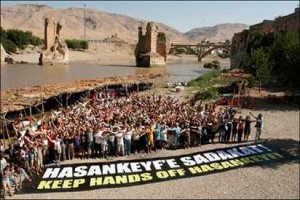
Hands off Hasankeyf!

Source: Kurdistan Tribune


Despite opposition from local Kurds and conservationists across the world, the Turkish government looks set to press ahead with its Ilisu dam project. This will flood the historic town of Hasankeyf – one of the oldest continually inhabited places in the world – and forcibly displace around 55,000 people from dozens of villages in Batman and adjacent provinces of Turkey/north Kurdistan.

Read the full article Hands off Hasankeyf!

Saif Badrakhan - Representative of KNK speaks to Swana Radio

Streaming at http://archive.kpfk.org/index.php?shokey=rintifada and available on audio archive for 90 days

Originally Broadcast Wednesday, September, 5th 2012, 2:30-3:00 PM KPFK/Pacifica Radio 90.7 fm, Los Angeles

Produced by Nyma Ardalan - SWANA (South and West Asia and North Africa) Collective, KPFK

Note. Kongra Netewia Kurdistan (KNK)- Kurdistan National Congress is the largest Kurdish congress in Exile it includes 32 Kurdish political parties and organisations

Syrian Kurds will not fight each other: Kurdish KNC leader

Source: AK News via eKurd


ERBIL-Hewlêr, Kurdistan region 'Iraq',— Deputy for head of the umbrella organization of Kurdish National Congress (KNC) said there is no possibility of fratricide war among the Kurdish parties in Syria.

"Those who bet that Kurds will face fratricide war in the Syria after the [fall of Bashar al] Assad are just dreaming," said Bengi Haco.

Haco added Kurds in Syria are faced with no threats of fratricide war "at all… All the political parties and forces are united over the patriotic and national issues, especially after singing Erbil agreement."

The agreement, signed under the supervision of Kurdistan Region's President Massoud Barzani, united two major Kurdish alliances in Syria: The People's Council of Western Kurdistan and the Kurdish National Council of Syria.

KNC official said Kurds have always preferred holding dialogue to exercise of violence for settling any issue and will maintain this policy for resolving the Kurdish issue in Syria.

Haco urged the Syrian National Council (the Arabic opposition front) to admit to the ethnic rights of Kurds in the phase after the fall of Assad's regime.

He said " Kurds will not be content with a centralized authority in the current or the future Syria because they demand a decentralized government be created,www.ekurd.net the rights of Kurds and other nations be protected and democracy be established.

"Kurds in Syria live on their own land… Their soil has been divided [among Iran, Turkey, Syria and Iraq] by force and against their wish.

"Therefore, those who say they will give Kurds [their] rights are wrong because they are [living] on the Kurdish land and have to admit to their rights…"

Syrian Kurds will stay away from the "sectarian" war in Syria and will maintain their unity until their rights as a distinct nation in Syria are granted, said Haco.

The statement by Bengi Haco was made on Tuesday during a press conference in Ciwarcira Hotel in Erbil, capital of the Kurdistan Region.

Haco said "our purpose behind the visit to Southern Kurdistan [Iraqi Kurdistan Region] is to support the Erbil agreement which was signed by the Kurdish forces and political parties of Syria under the supervision of Kurdistan Region's President Massoud Barzani."

The agreement united the People's Council of Western Kurdistan (PCWK) and the Kurdish National Council of Syria (KNCS). PYK (Democratic Union Party), as the major component of the PCWK, has strong links with the outlawed Kurdistan Workers Party (PKK) in Turkey.

The KNC official described the agreement "an important stride" for keeping the Kurds away from any dangers to the high interests of Kurds and "a means for uniting Kurds' position in Syria."

Commenting on the violence in the Middle East, Haco said "what is done today in the Middle Eastern countries is a sectarian war and Kurds will not engage themselves in this war.

"Kurds in Syria are trying to stay away from this war and bloodshed …. and to hold talks for obtaining their rights."

Haco described the position of the Arab opposition front in Syria "worrying.

"They are not unified among themselves, 60% of the[Arab] Syrian opposition believes in the centralized authority…. They have always opposed democracy and human rights."

However, for Kurds of Syria, Haco thought "90% of Kurds of Syria are united against any different position among Kurdish ranks.

By Fryad Mohammed, AK News